Clean exhaust air without a flame
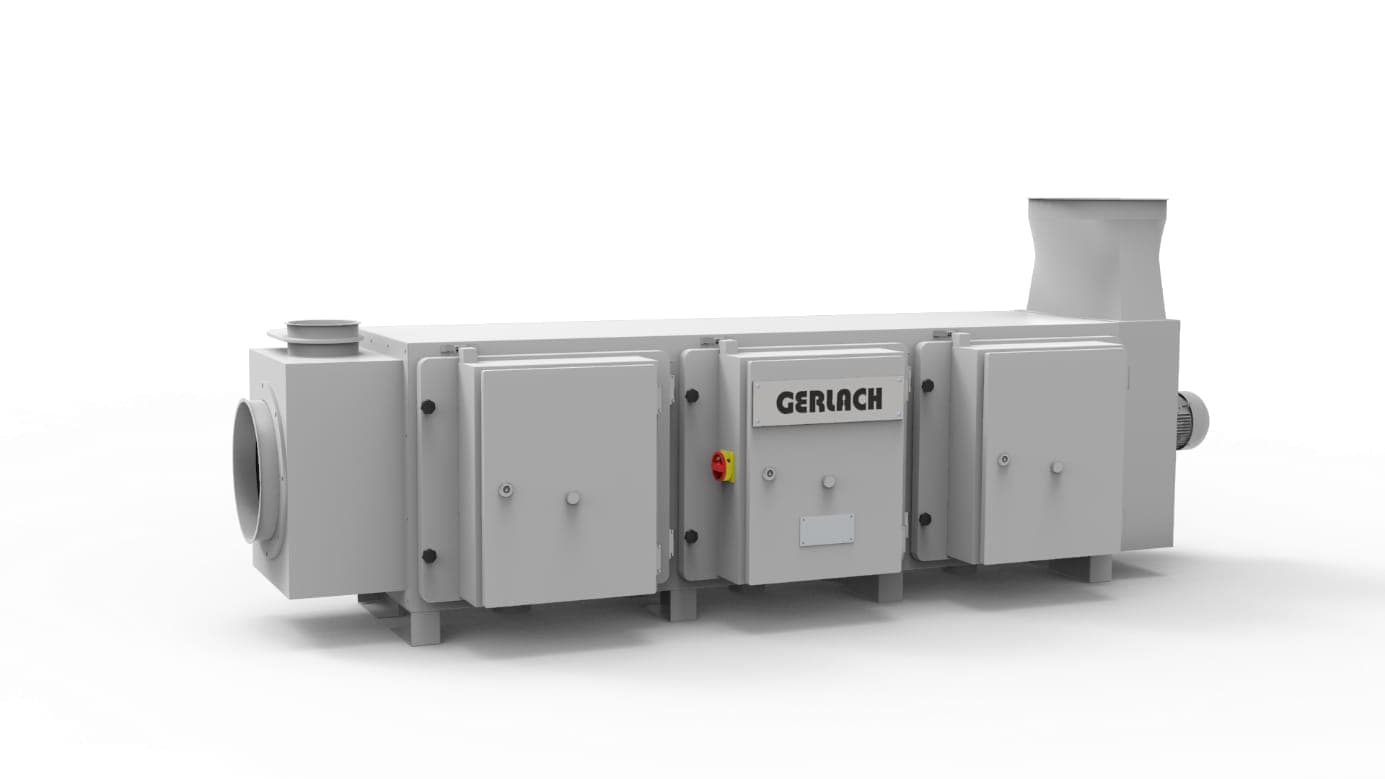
Electrostatic exhaust air cleaning for vulcanisation lines, tempering ovens and equipment from other manufacturers. No burner, no gas, no change to your process.
Built by Gerlach Maschinenbau, a Rameckers Group company – supplied by TSM as part of your line or as a retrofit. Gerlach Maschinenbau
What does your exhaust air treatment really cost?
On gas-heated vulcanisation lines with thermal post-combustion, exhaust cleaning can use up to half of the line's energy. The burner runs whenever the line runs. Gas bills and CO₂ emissions rise with it, and every maintenance stop of the system usually stops production as well.
In many plants this share has never been calculated separately. Once it is, the potential is often obvious.
Electrostatic filtration in four stages
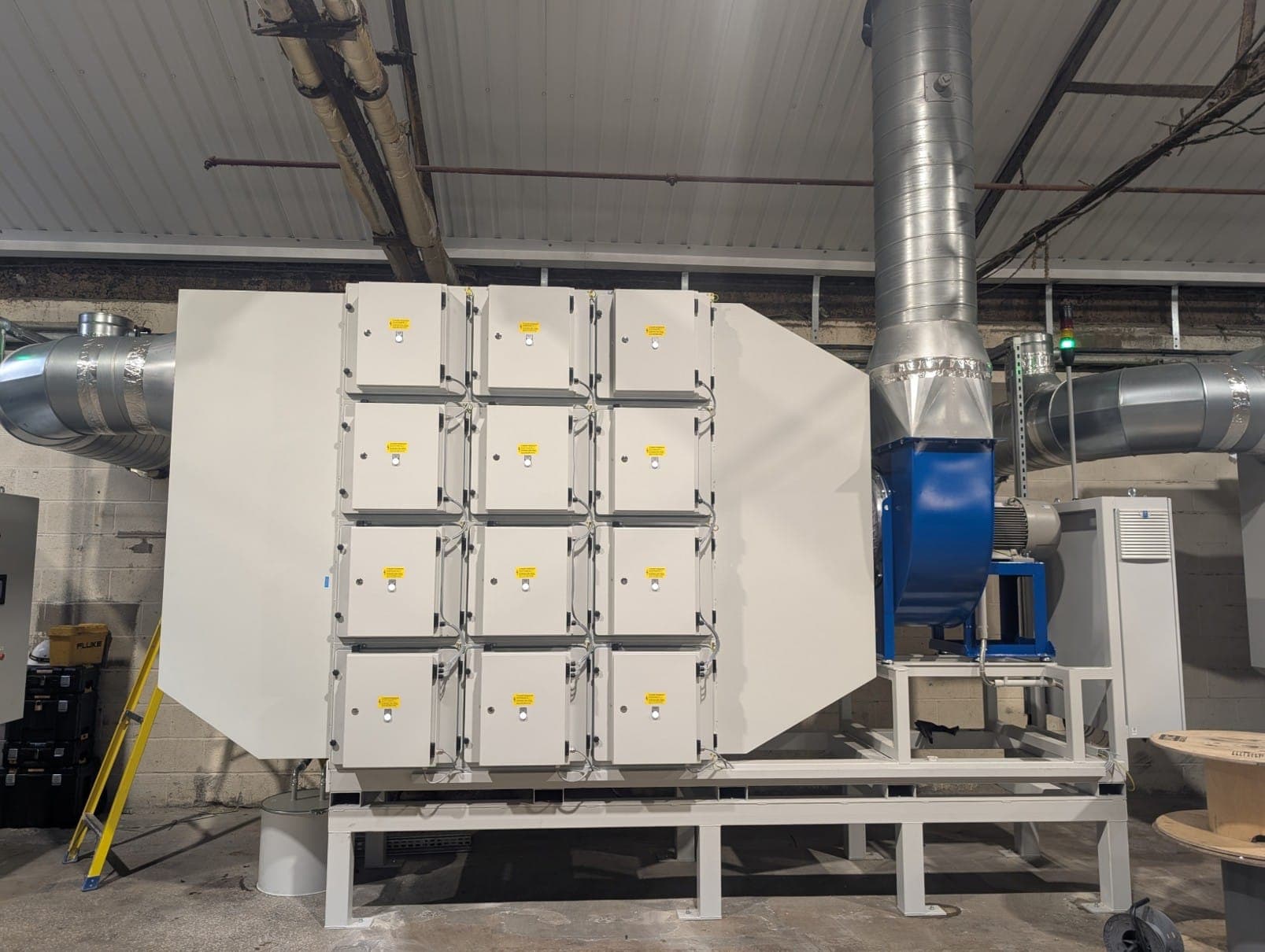
The electrostatic precipitator removes contaminants from the exhaust air electrically instead of burning them:
- 01
Pre-filter
Retains coarse contamination.
- 02
Ioniser
Gives the solid and liquid particles in the exhaust air an electrical charge.
- 03
Collector
The charged particles settle on the plates of a high-voltage field.
- 04
Post-filter
Neutralisation on a grounded filter.
This separates at least 99 % of electrostatically chargeable particles from 0.03 µm upwards.
What you gain
No gas, no burner
Exhaust cleaning only needs electricity, mainly for the fan. Your energy costs become predictable.
Much less CO₂
Instead of direct emissions from burning gas (Scope 1), only the electricity demand remains, and it falls further with green power.
No process changes
Process parameters and air flow stay as they are.
Retrofittable
On lines from TSM, Gerlach and other manufacturers.
Modular sizing
The number of filter stages is set by the air volume and the level of contamination, so the precipitator is sized to your application.
Integrated
The filter status is shown directly on the operator panel of the machine or oven.
What customers save
Measured on a 12 m vulcanisation section in three-shift operation, 260 days a year: thermal post-combustion cost €15,017 in energy per year, the electrostatic precipitator €3,370. CO₂ emissions fell from 43.1 t to 4.7 t per year.
Customer project, rubber
A rubber processor cleaned the exhaust of three lines with a central RTO (93,000 m³/h) that used around 130,000 kWh of gas a week. Today five decentral electrostatic precipitators with 16,000 m³/h each do the job. No gas is needed for exhaust cleaning any more, and the project paid for itself in 2.8 years from energy savings alone.
Customer project, silicone
A silicone processor compared all known filter technologies for its tempering ovens and chose the electrostatic precipitator on total cost of ownership: 10,000 m³/h, integrated into the oven control.
Basis: gas €0.07/kWh, electricity €0.27/kWh. Customer examples anonymised. Results depend on equipment and operation.
Fits your line
The precipitator works independently of the vulcanisation technology and of who built your equipment:
- Hot-air channels, gas or electrically heated
- Microwave and UHF lines
- Tempering and post-curing ovens
- Black rubber (EPDM, NBR and others) and silicone
- Complete seal profile lines from TSM and Gerlach
- Equipment from other manufacturers as a retrofit
The precipitator is modular: the number of filter stages sizes it to the air volume and contamination of your application. Independently of this, we decide together in the project whether one central system or decentral units per line are the better solution.
For tempering ovens, too
Our lines are designed for continuous processing. The electrostatic precipitator goes further: especially in silicone processing, it is also well suited to the exhaust air of tempering and post-curing ovens.
No silica dust
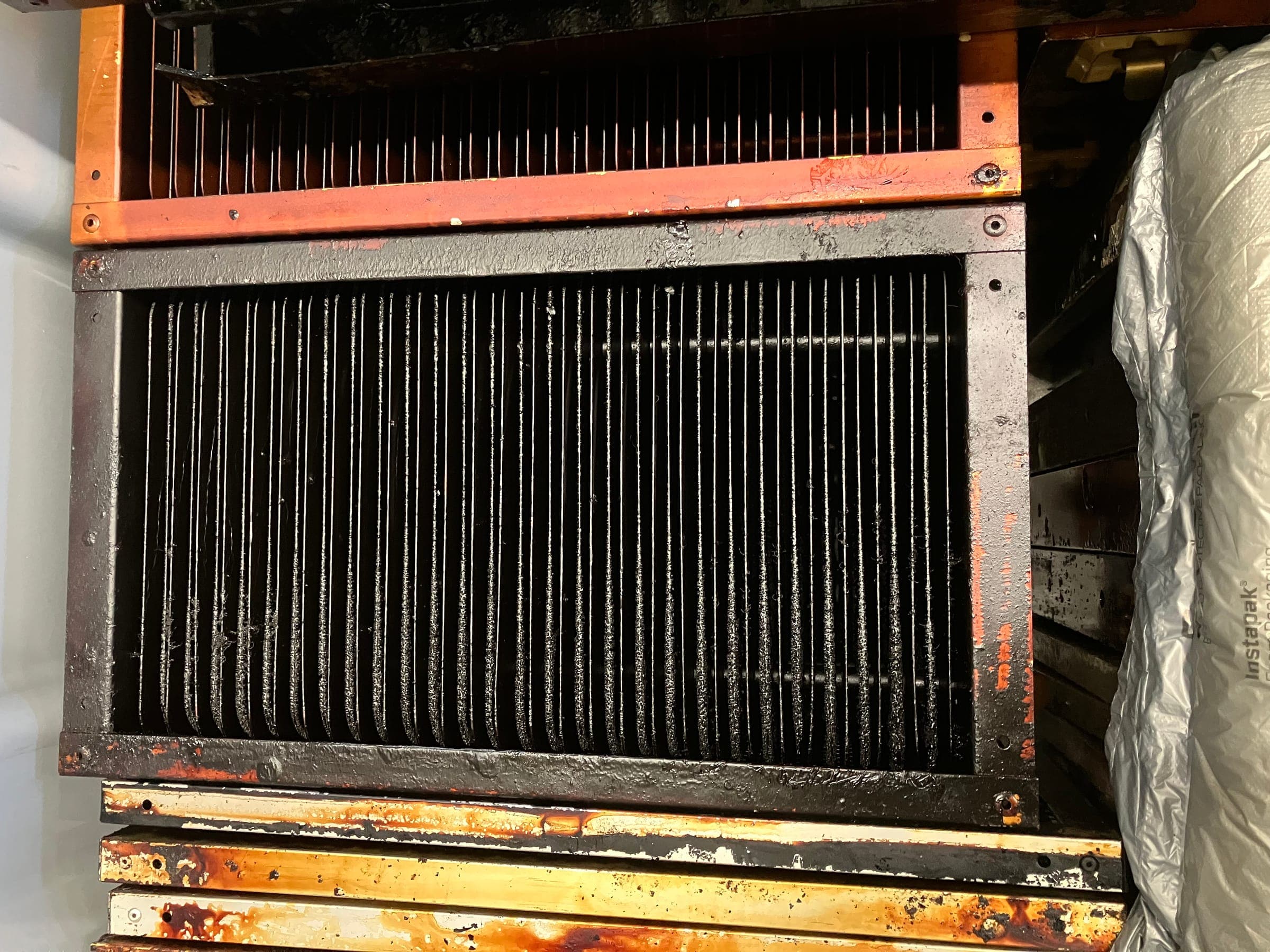
In thermal systems, siloxanes in silicone exhaust oxidise to silica dust. The electrostatic precipitator burns nothing – the residues collect in the filter cells.
Integrated into the oven control
The precipitator can be connected to the oven control, and the filter status is shown directly on the oven's operator panel.
Retrofittable
No change to process parameters or air flow – also on existing ovens from other manufacturers.
From practice: a silicone processor compared all known filter technologies for its tempering ovens and chose the electrostatic precipitator on total cost of ownership – 10,000 m³/h, integrated into the oven control.
Typical applications
- Automotive sealsElectrostatic exhaust air cleaning without burner or gas.
- Windows & façadesElectrostatic exhaust air cleaning without burner or gas.
- Medical technologyElectrostatic exhaust air cleaning for the line and tempering ovens – no silica dust with silicone.
- Food & agricultureElectrostatic exhaust air cleaning for the line and tempering ovens – no silica dust with silicone.
Thermal post-combustion or electrostatic precipitator?
| Feature | Thermal post-combustion | Electrostatic precipitator |
|---|---|---|
| Energy source | Gas burner, e.g. 70 kW installed | Electricity: approx. 1 kW per filter stage plus fan |
| Heating of exhaust air | Above process temperature | Not needed |
| CO₂ | Direct, on site (Scope 1) | Only via electricity (Scope 2) |
| Silicone exhaust | Siloxanes burn to silica dust, deposits | Residues collected in the filter cells |
| Process | Depends on the system | No change to parameters or air flow |
| Maintenance | Burner, heat exchanger | Regular cleaning or exchange of filter cells |
Electrostatic precipitator
| Function | Electrostatic filtration |
|---|---|
| Air volume | Modular, any air volume possible; configuration depends on the application |
| Separation efficiency | ≥ 99 % for electrostatically chargeable particles from 0.03 µm (DIN EN 1822 / ISO 35 H) |
| Energy demand | Approx. 1 kW per filter stage plus fan (efficiency class IE5), depending on the air volume |
| Module dimensions L × W × H | 2.50 × 0.7 × 1.3 m |
| Air inlet nozzle | 300 mm |
| Electrical | Integrated switch cabinet, 230/400 V, 3 ph, PE + N |
| Control | Integrated, autonomous; can be connected to the machine control |
| Inspection | Lockable inspection door per filter stage |
| Standards | CE |
| Colour | RAL 7035 |
Maintenance you can plan
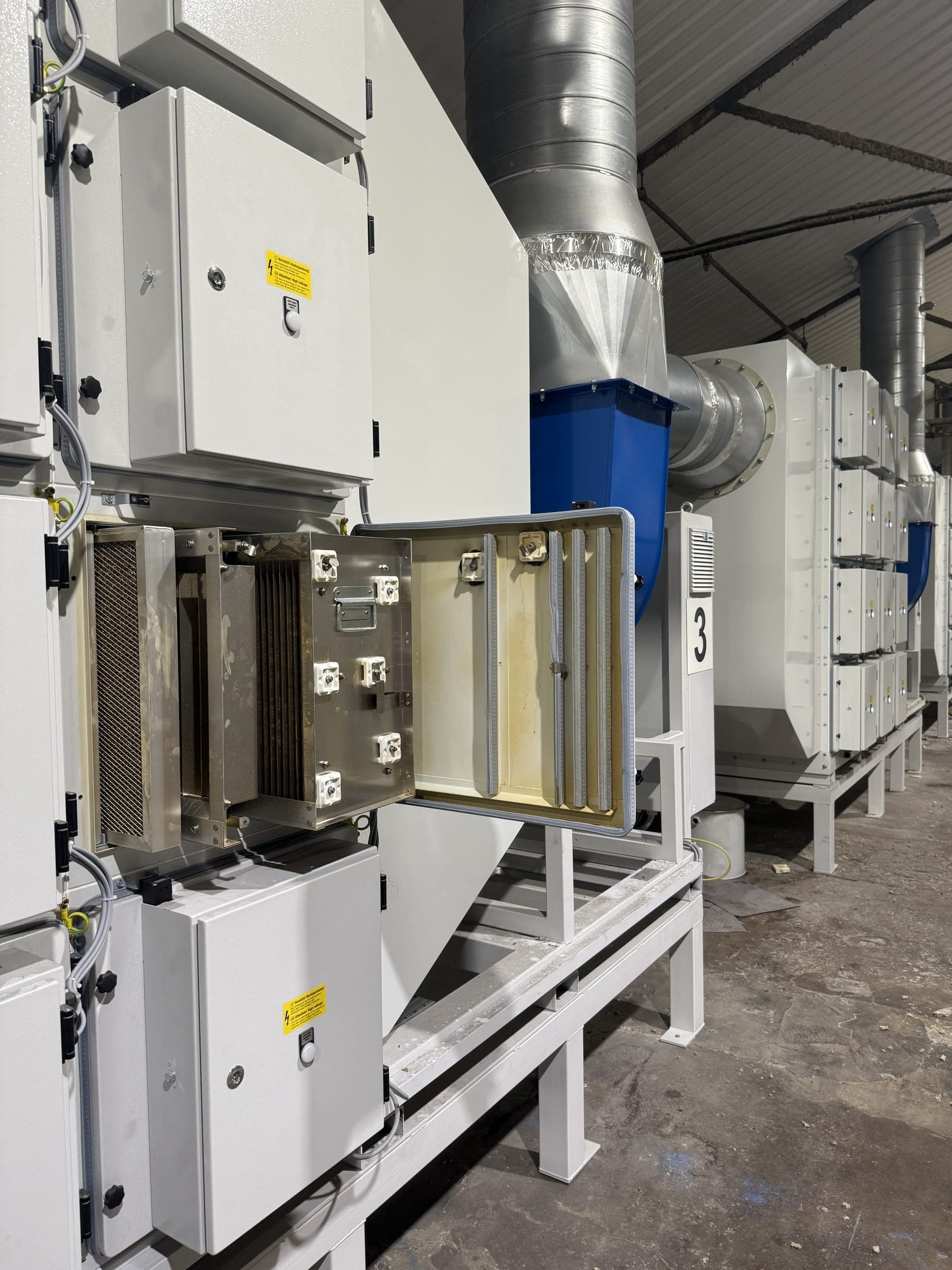
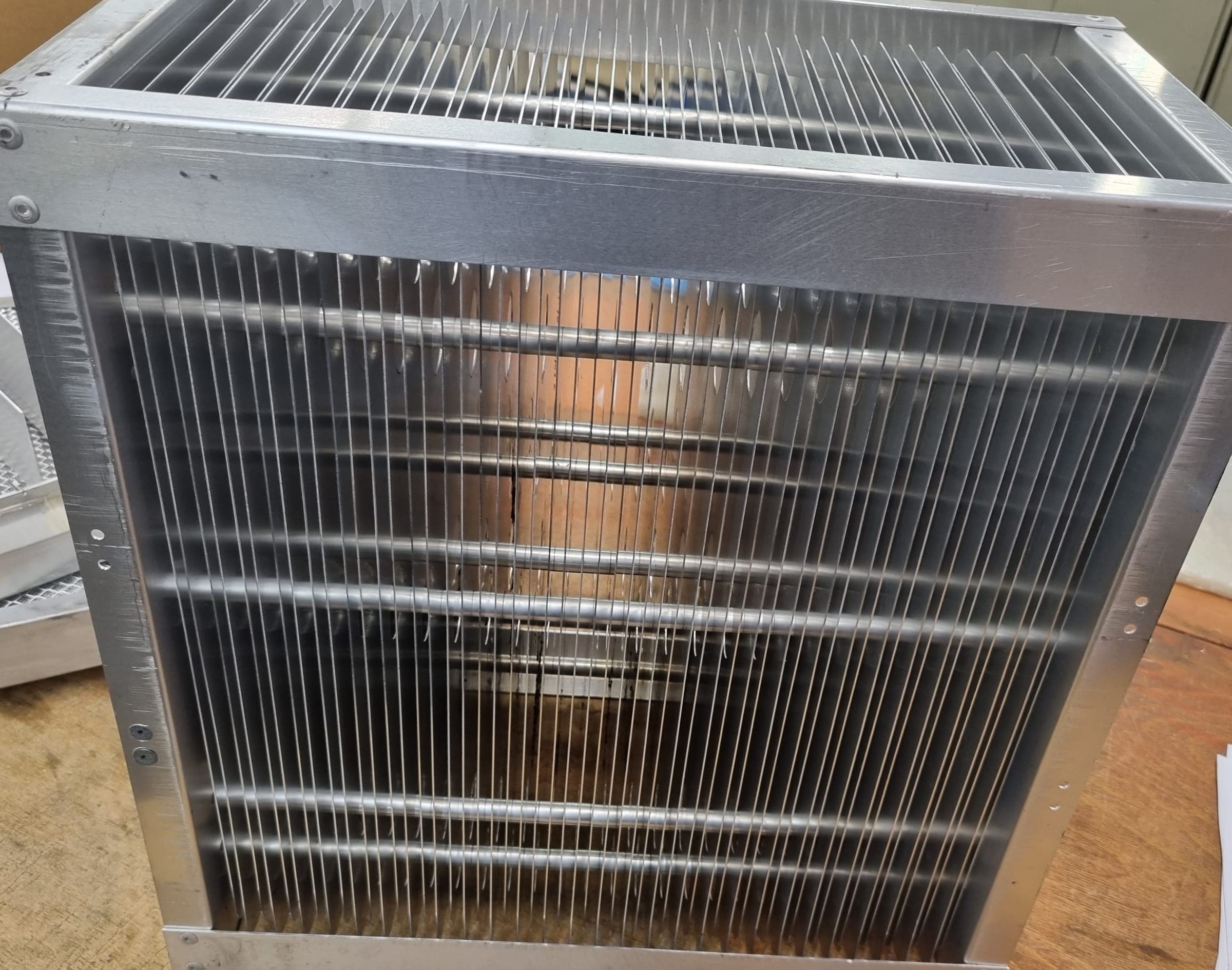
An electrostatic precipitator keeps what it removes from the air, so the filter cells are cleaned regularly. Each filter stage has its own door, and the cells come out from the front.
Under a maintenance contract you receive an exchange set of filter cells. You swap them yourself in a few minutes. You send the dirty cells back to us – we clean them ultrasonically, dispose of the cleaning water properly and send you a clean set again. With this rotating system you always have clean filter cells ready for the next exchange. An annual service is also included.
From the first call to clean air
- 01
Feasibility study
We analyse your process and exhaust air and check what can be separated electrostatically.
- 02
Sizing and TCO
Filter size, number of stages and a cost comparison with your current solution.
- 03
Integration
Installation, connection to your machine control, commissioning.
- 04
Service
An optional maintenance contract, tailored to your shifts.
Frequently asked questions
What does a system cost?
It depends on the air volume, the level of contamination and the number of filter stages. The feasibility study gives you the sizing and a cost comparison with your current solution.
How much electricity does the filter need?
About 1 kW per filter stage. Most of the power goes into the fan, which depends on the air volume. No gas is needed.
How efficient is the separation?
At least 99 % for electrostatically chargeable particles from 0.03 µm. Whether this meets your exhaust air and limits is confirmed in the feasibility study.
Does it fit equipment from other manufacturers?
Yes. The filter works independently of the vulcanisation technology and can be retrofitted without changing process parameters.
Does it work with silicone?
Yes – on the line as well as on tempering and post-curing ovens. Nothing is burnt, so no silica dust is formed. The residues collect in the filter cells and are removed during cleaning.
How much maintenance is needed?
The filter cells are exchanged regularly. With a maintenance contract you receive an exchange set: you swap the cells yourself in a few minutes, send the dirty ones to us and get a clean set back.
Can I connect several lines?
Yes. Whether one central system or decentral units per line make more sense is something we decide together in the project. A decentral solution is often a good fit because it reduces ductwork and therefore cleaning effort – but it always depends on the conditions in your plant.
A second technology in our range
For catalytic post-combustion, TSM offers the CT 1000 for 1,000 to 3,000 m³/h.
Is it worth it for your line?
The quickest way to find out is a short call. Tell us which line you run and how you clean the exhaust air today, and we will come back to you with a first assessment.